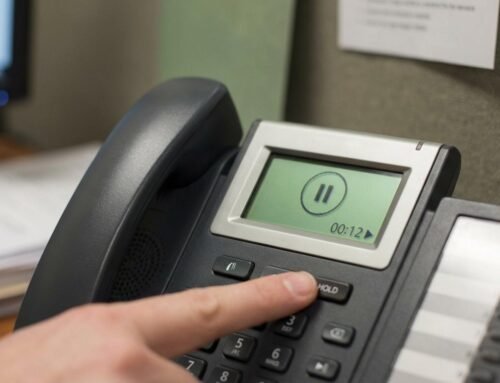


If your business phone system plays music while callers wait, you are “performing” that music to the public. That simple fact catches many Irish organisations off guard, because the same song that feels harmless on a personal playlist can bring real licensing obligations once it’s piped into a queue or IVR.
Choosing between royalty-free music and licensed, chart music is not just a taste question. It affects cost, admin time, legal risk, and even how clear your spoken messages sound over the line.
Why phone system music is treated differently
Music on hold is not private listening. Your callers are outside your organisation, and they are hearing a recording that your business has chosen to transmit. Under Irish copyright rules, that typically means you need permission from the rights holders unless the music is supplied with a licence that already covers this use.
In Ireland, permission for mainstream recorded music usually sits across two areas: the composition (songwriting) and the sound recording (the master). In practice, businesses often deal with licensing through IMRO and PPI (often packaged as a dual licence), with fees that can be billed on an ongoing basis.
That is why “we already bought the CD” or “we have Spotify” does not solve the problem. Buying consumer music gives you the right to listen, not the right to broadcast it to customers through a phone platform.
What “royalty-free” actually means for on-hold use
“Royalty-free” is widely misunderstood. It does not mean “free of charge”. It usually means you pay once for a licence and you do not pay ongoing royalties for continued use, within the terms of that licence.
For phone systems, the practical attraction is simple: you can select a track that is already cleared for commercial use on hold, without managing annual payments to music licensing bodies for that specific music.
Royalty-free libraries vary a lot, though. Some are generic stock libraries aimed at video creators. Others are produced specifically for telephony, with arrangements that stay clear and pleasant once the audio is compressed by phone codecs.
A quick sense-check helps. Before you upload anything, ask what you are actually buying.
After you confirm the basics, it helps to keep a short internal checklist:
- One-time fee
- On-hold and IVR use allowed
- Proof of licence available
- Track can be edited or looped
If a supplier cannot clearly answer those points in plain language, treat it as a risk.
Licensed music: when it is tempting, and what it brings with it
Licensed, well-known music can feel like the “premium” choice because it is familiar. You might think it will keep callers happier, or reflect a certain brand personality.
Sometimes that is true. More often, it causes new issues:
- The admin does not stop: fees and renewals are usually ongoing.
- The rights can be complicated: composition and master recording rights are separate.
- The music may clash with your message: a vocal track competes with voice prompts.
- Audio quality can disappoint: what sounds rich on speakers can turn thin on a phone line.
There is also brand risk. A popular song can age quickly, can be overused, or can feel inappropriate during a serious call. Familiarity is not the same as suitability.
A clear comparison for Irish businesses
The biggest difference is not genre or popularity. It is the licensing model and the operational burden that comes with it.
| Aspect | Royalty-free music (cleared for on-hold use) | Licensed commercial music (mainstream catalogue) |
|---|---|---|
| Payments | Typically a once-off fee | Often ongoing fees via licensing bodies |
| Permissions | Usage rights are granted in the licence terms | Permission required for public performance, usually managed via IMRO and PPI |
| Paper trail | Supplier should provide a simple licence or confirmation | Licence documentation and renewals are your responsibility |
| Flexibility | Usually can be looped, trimmed, and mixed under the licence terms | Editing is often restricted without additional permissions |
| Caller experience | Can be chosen to suit telephony clarity | Can sound muddy or distracting over phone codecs |
IMRO/PPI: what you may need to consider
If you use copyrighted commercial music, your business may need licensing that covers both the composition rights and the recording rights. In Ireland this commonly involves IMRO and PPI, often presented together as a dual music licence in business contexts.
Fees and terms depend on how the music is used and the scale of your operation. The important operational point is this: it is not a “buy once, sorted” situation. It tends to be a continuing obligation.
Royalty-free on-hold music is popular largely because it side-steps that ongoing admin, provided the track is genuinely cleared for phone use and not tied back to performing rights claims.
Phone audio is harsh: pick music that survives compression
Most phone systems do not play audio the way your laptop does. Traditional telephony and many VoIP setups narrow the frequency range and reduce detail. Deep bass disappears. Subtle reverb becomes mush. Busy mixes can turn into noise.
So the “best” on-hold track is rarely the most cinematic one. It is the one that remains steady and clean when it is squeezed through a narrow audio channel.
A practical way to choose is to think like a caller, not like a producer: they want calm, consistency, and clarity. Your music should create a bed for information, not become the centre of attention.
After you have a short list of tracks, look for these traits:
- Simple arrangement: fewer competing elements make speech clearer.
- Mid-range focus: guitars, keys, light percussion often translate well.
- Controlled dynamics: fewer dramatic quiet-loud jumps.
- No distracting vocals: spoken announcements stay intelligible.
That last point matters more than people expect. A vocal hook can mask a phone number, opening hours, or an important queue message.
Matching music to brand without sounding generic
“Royalty-free” has a reputation for sounding like stock music, mainly because people pick the first free-sounding track they find. Good libraries, and good producers, avoid that by focusing on musical tone and pacing.
A clinic, a local authority office, and an emergency call-out line all need something calmer than a gym membership sales line. A luxury retailer might want something minimal and polished. A tech firm may prefer modern, neutral textures.
The goal is not to impress the caller with your soundtrack. The goal is to keep them confident that they are in the right place, and that their call is progressing.
Sometimes a single sentence in the script can do more for brand perception than any melody: “Thanks for calling, we will be with you shortly” in a clear, local voice, at a comfortable level, is often what callers remember.
How a specialist service keeps it simple
Many Irish businesses prefer to buy on-hold audio as a finished piece rather than assembling it themselves. That is where a specialist service like OnHold.ie fits well. The model is straightforward: professional Irish voiceovers, music that is cleared as royalty-free for on-hold use, and audio delivered as ready-to-upload files for your phone system.
OnHold.ie’s approach is also shaped by the practical pain points businesses mention again and again:
- pay-once pricing rather than annual licences for the music provided
- no contracts for ongoing music usage
- royalty-free tracks selected for suitability on phone systems
- recordings optimised for telephony formats
That combination reduces the two common failure points: unclear licensing and bad audio formatting.
File formats, looping, and the small details that matter
Even with the right music, uploads can go wrong. Phone systems often require specific formats, and different platforms have different ideas about what “WAV” means.
A few operational details are worth checking with your phone provider or IT team:
- Does your system need WAV, MP3, or a specific codec?
- Is it mono only?
- What is the recommended loudness level?
- How does the system loop the audio, and will your track loop cleanly?
Clean looping matters. A track that clicks or jumps every 30 seconds will irritate callers quickly, even if the music itself is pleasant.
It also pays to separate “music only” and “music plus voice” versions, if your system supports it. Some setups play music on hold but use separate prompts for queue positions or estimated waiting times. Others need one combined file.
Keeping your compliance tidy
It is not enough to “be sure” you have rights. You should be able to show them if asked.
A simple internal record is usually enough:
- what track you used
- who supplied it
- what the licence says about phone/on-hold use
- when you purchased it
- where the proof is stored (email, PDF, invoice)
If you ever change your phone platform, this record also makes migrations easier. You can hand your new provider the correct files and the licensing proof without digging through old inboxes.
Updating your on-hold audio without creating extra work
Caller messaging changes all the time: opening hours, seasonal closures, service disruptions, payment options, new locations. Your on-hold audio should be easy to refresh without resetting your licensing position each time.
That is another reason royalty-free, telephony-ready music is popular. If the music bed is already cleared and fit for purpose, you can focus on the voice and the information, and update the content when needed without turning it into a licensing project.
If you are planning a refresh, a useful starting point is to pick the tone you want callers to feel in the first ten seconds, then choose music that supports that tone, and only then write the messages that matter to your customers.